
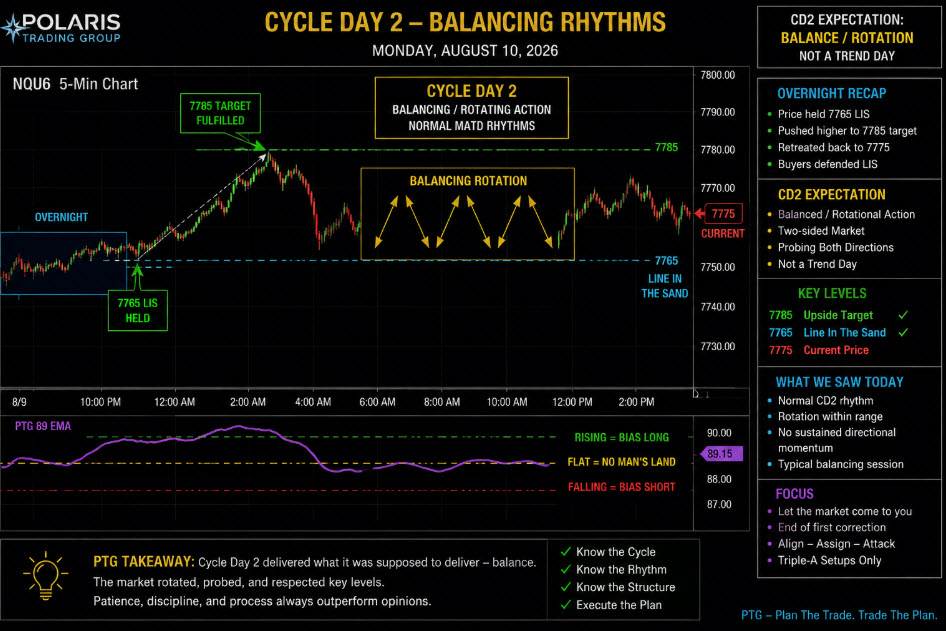
Cycle Day 2 — Balance Means Balance
Monday kicked off the new trading week with a fairly straightforward assignment:
Cycle Day 2 + normal MATD rhythms.
And unlike those days when Mr. Market decides to rewrite the playbook before lunch…
Today he pretty much followed the script.
🌙 Overnight Action — 7765 Holds the Line
Overnight price successfully defended our 7765 Line in the Sand (LIS) and pushed higher, fulfilling the initial 7785 upside objective.
🎯 7765 LIS — HELD
🎯 7785 Target — FULFILLED
Mission accomplished.
Following the target fulfillment, price rotated back toward 7775, setting the stage for the regular session.
The important takeaway was simple:
Buyers defended the LIS, completed the upside objective, and then momentum cooled.
No mystery.
No conspiracy.
Just auction mechanics doing auction things.
🔄 Regular Session — Welcome to Cycle Day 2
Today was a Cycle Day 2, where our normal expectation is for MATD balancing rhythms rather than blindly anticipating directional expansion.
And that is essentially what we received.
Price spent much of the session rotating, probing, reversing and generally reminding traders that:
Not every day is designed to trend.
Cycle Day 2 frequently becomes the market’s workshop.
Inventory gets adjusted.
Levels get tested.
Both sides probe for weakness.
And traders who insist upon forcing a trend can quickly find themselves donating commissions to the exchange.
By late afternoon, there simply wasn’t much additional drama to report.
Today’s market behaved like a fairly typical Cycle Day 2 balancing session.
Sometimes the best market commentary really is:
It did exactly what it was supposed to do.
🎓 The 89 EMA — Today’s Classroom
One of today’s more valuable discussions centered around the 89 EMA and its role within the PTG methodology.
The core concept:
The 89 EMA is the structural anchor.
When the 89 EMA is clearly rising, the directional bias favors looking for quality LONG opportunities.
When the 89 EMA is clearly declining, the directional bias favors looking for quality SHORT opportunities.
When the 89 begins flattening?
🚫 No man’s land.
As was nicely summarized in the room:
“Flattening 89 = no trade.”
Simple doesn’t mean simplistic.
The supporting indicators can provide additional confirmation and identify tactical probe opportunities, but they do not replace the primary structural message coming from the 89 EMA.
The market doesn’t pay extra because you managed to put seventeen indicators on the screen.
Sometimes one clean piece of information is worth more than an entire Christmas tree of blinking signals.
🎯 First Pullback — Let the Market Come to You
Today’s discussion also returned to one of PTG’s favorite execution principles:
“The safest place to look for a new trade is at the end of the first correction to a new swing.” — W.D. Gann
That concept remains timeless.
Identify direction.
Allow the initial move.
Wait for the correction.
Then evaluate the First Pullback.
In PTG language:
Alignment → Assignment → Attack
Not:
Guess → Chase → Pray.
The first approach is a trading process.
The second approach is how new monitors occasionally get ordered.
🧰 Trade the Toolbox — Not Every Tool
Another useful theme emerged from today’s room discussion:
You don’t need every PTG strategy firing simultaneously.
You need to understand the market condition, identify the appropriate tool, and execute when your criteria align.
ATR strategies can run hot.
They can run cold.
Opening Range opportunities appear when conditions support them.
First Pullbacks require an established swing.
And the 89 EMA provides an important structural filter.
The objective isn’t to collect signals.
The objective is to identify high-quality alignment.
That’s why we continue emphasizing:
Triple-A setups only.
There will always be another trade.
Capital preservation ensures you’ll still be around to take it.
📚 Simulation Before Speculation
Another excellent point raised in the room concerned traders evaluating the PTG Toolbox.
Rather than debating hypothetical win rates, traders can use simulation mode to study the strategies firsthand.
Track the setups.
Measure the outcomes.
Understand MAE/MFE.
Learn how execution affects results.
Then determine whether the methodology fits your individual trading style and risk tolerance.
That’s how professional traders build confidence:
Evidence first. Capital second.
📅 Looking Ahead
Monday may have been relatively quiet, but the economic calendar ahead is anything but.
This week brings significant economic releases, including:
📌 CPI — Wednesday
📌 PPI — Thursday
Those releases have the potential to materially alter volatility and auction behavior.
So enjoy the quieter rotational environment while Mr. Market is offering it.
The volume knob may get turned up shortly.
🧠 PTG EDUCATIONAL TAKEAWAY
Today’s lesson wasn’t about catching some heroic 40-point directional move.
It was about recognizing the environment you’re trading.
Cycle Day 2 said balance.
Price delivered balance.
The 89 EMA helped define structural bias.
The First Pullback remained the preferred location rather than chasing price.
And patience remained a legitimate trading position.
That’s professional trading.
You don’t tell the market what it should do.
You identify what it’s actually doing…
and select the appropriate tool.
Know the Cycle.
Know the Rhythm.
Know the Structure.
Then execute.
Because sometimes the highest-quality trade of the day…
is the one you were disciplined enough NOT to take.
PTG — Plan the Trade. Trade the Plan.