
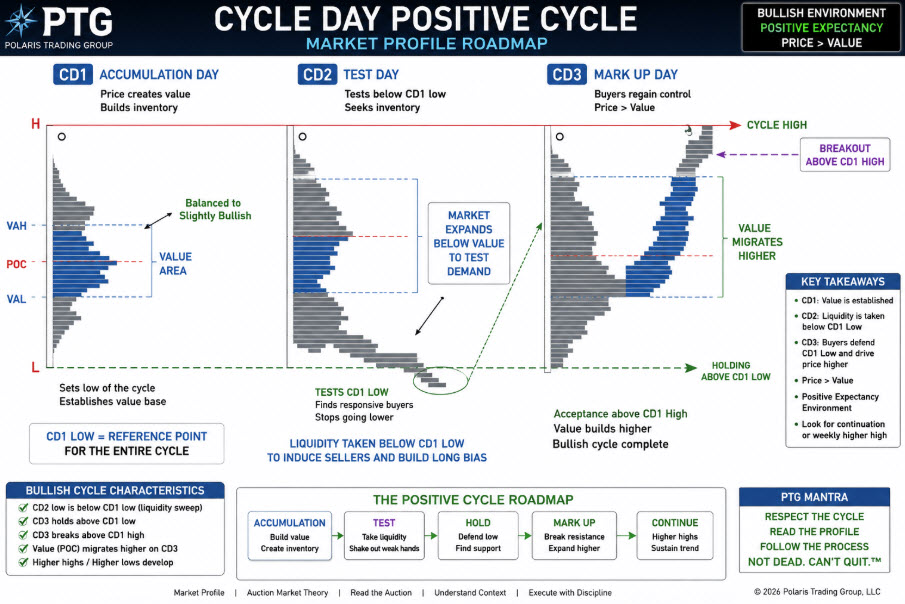
Cycle Day 3 — FRYday, August 14, 2026
Running on Empty — And Smart Enough to Know It
FRYday arrived with two things already firmly established:
- The market had just printed another All-Time High.
- PTGDavid’s internal battery indicator was flashing LOW POWER MODE. 😂
After Thursday’s rip to fresh historical highs, the overnight session did exactly what exhausted markets often do after throwing a party:
Not much.
Price pulled back from the ATH and spent the overnight session confined to a relatively narrow band.
And because this was Cycle Day 3, the statistical backdrop remained constructive.
But there was another statistic deserving equal respect:
FRYDAY IS CAPITAL PRESERVATION DAY.
Sometimes the best trade on Friday afternoon is the one you never put on.
🔔 Opening Bell — Balance Before Bravado
The opening sequence quickly presented as:
Neutral Balanced
Translation:
Neither side had enough conviction to take ownership of the auction.
Buyers pushed.
Sellers pushed back.
Price rotated.
Everyone stared at their indicators waiting for one of them to reveal the meaning of life.
None did.
This was not an environment demanding aggressive prediction.
It was an environment demanding observation, patience and acceptance of the auction process.
After Thursday’s expansion, the market appeared perfectly content to digest.
The dreaded summertime CHOPFEST was officially lurking in the bushes.
📊 Market Profile Took Center Stage
With price balancing, the session became an excellent opportunity to move away from simply staring at candles and instead examine the structure of the auction.
PTGDavid walked the room through Market Profile concepts, including:
- Profile Day Types
- Balance versus imbalance
- Standard deviation
- Value development
- Volume nodes
- Intraday profile construction
- Value-area behavior
- Breakout structure
The important distinction was simple:
Price tells you where the market traded.
Profile helps explain how the auction got there.
When markets are trending, everyone suddenly becomes a genius.
Balanced markets are where traders discover whether they actually understand auction structure.
🎯 The Value Breakout Template
The morning’s major educational segment centered around the Value Breakout Template.
The framework wasn’t designed to predict where price should go.
It was designed to identify when the auction had actually transitioned from:
BALANCE → ACCEPTANCE → EXPANSION
That distinction matters.
A price poking outside value is not automatically a breakout.
Markets routinely stick their nose outside established value, discover nobody wants to follow them, and retreat directly back inside.
That is not expansion.
That is the market saying:
“Never mind.”
Acceptance outside value is the key.
Once participation confirms the move, the auction has the potential to migrate toward the next area of interest.
Until then?
Patience.
🧠 Delta — Green Doesn’t Always Mean Bullish
The room also dug into an excellent question concerning Delta.
Why could Delta remain green while price failed to continue higher?
Because aggressive buying does not guarantee higher prices.
If buyers repeatedly lift offers while price refuses to advance, somebody may be sitting on the other side absorbing everything being thrown at them.
That creates one of the more useful order-flow lessons:
Effort without result matters.
Lots of buying + little upward price progress can indicate absorption.
And sometimes the most important information isn’t what Delta is doing.
It’s what price refuses to do despite the Delta.
The footprint tells the story.
Price delivers the verdict.
⏰ Time Zone 2 — Character Change
Around the 10:10 area, the room began recognizing a change in the character of the auction.
The discussion turned toward whether the downturn had effectively begun around Time Zone 2.
This reinforced another recurring PTG principle:
PRICE + LEVEL + TIME
Any one of those variables can be useful.
When multiple variables converge?
Now the market has our attention.
As always, the goal isn’t mystical prediction.
It’s recognizing when independent pieces of information begin telling the same story.
📉 The Ugly Side of Expectancy
One of the strongest discussions of the session had absolutely nothing to do with today’s P&L.
The room revisited a previous stretch where a strategy experienced approximately nine weeks of negative expectancy before eventually recovering.
John B added a particularly useful real-world example.
During July 2026, he had fallen roughly -10R before two late-month trades recovered the drawdown and pushed the month back to approximately +1R.
The temptation during the drawdown?
Stop trading the strategy.
Had he done so, he would have potentially abandoned the process immediately before the recovery.
That’s trading.
A positive expectancy does not mean:
Win → Win → Win → Win → Lamborghini.
It means that over a sufficiently meaningful sample size, the mathematical edge should reveal itself.
The distribution along the way can be downright rude.
🧮 Know Your Numbers
This became perhaps the day’s most important lesson.
If you’ve properly tested a strategy and understand its historical metrics, then individual losing trades—and even losing streaks—must be viewed within that statistical framework.
You should know:
- Historical win rate
- Average winner
- Average loser
- Expectancy
- Maximum drawdown
- Losing streak distribution
- Standard deviation
- MAE/MFE characteristics
- Sample size
Otherwise you’re not evaluating a strategy.
You’re evaluating your latest emotional experience.
And markets are extraordinarily talented at making the most recent five trades feel like the most important five trades in human history.
They aren’t.
🔄 Taylor Trading Technique — Still the Secret Weapon
Later in the session, discussion returned to the Taylor Trading Technique and the structure of the Three-Day Cycle.
Questions centered around whether Taylor’s original work required a rigid:
CD1 → CD2 → CD3
count.
That opened discussion around the practical application of cycle structure, including one particularly valuable concept:
The CD1 Low Reclaim on Cycle Day 3
As ram correctly observed:
Using Taylor structure to recognize the reclaim of the CD1 Low on CD3 can be priceless.
Exactly.
The objective isn’t to worship the calendar designation.
The objective is to understand the behavioral rhythm underneath it.
Cycle structure provides context.
Price provides confirmation.
Execution still requires discipline.
No magic wand included.
🪄 Speaking of Magic Wands…
slatitude39 delivered perhaps the day’s definitive trading wisdom:
“Sears and Roebuck catalog has no magic wands available, therefore be diligent and persistent.”
There it is.
Decades of market literature condensed into one sentence.
No Holy Grail.
No secret indicator.
No magical oscillator.
No guy on YouTube who discovered the one setup Wall Street desperately doesn’t want you to know about.
Just:
Process.
Statistics.
Risk management.
Repetition.
Persistence.
Not nearly as exciting as a magic wand.
Much more effective.
🔌 And Then Technology Joined the Bear Camp
Around 11:34 AM, the PTG stream briefly lost connectivity.
Audio disappeared.
Charts disappeared.
Refresh buttons were assaulted.
F5 became the highest-volume instrument in the room.
Eventually audio returned, charts returned, and civilization was restored.
Apparently even the internet understood the day’s theme:
RUNNING ON EMPTY.
🎸 Today’s Official Theme Song
By 11:26 AM, PTGDavid finally acknowledged what had become obvious:
Jackson Browne — “Running on Empty.”
Appropriate.
The market was running on reduced post-ATH energy.
PTGDavid was running on fumes.
And FRYday liquidity wasn’t exactly auditioning for the Indy 500.
Sometimes the market gives you a theme.
Today it came with a soundtrack.
🏖️ FRYday Capital Preservation
The session began with a warning and ended by proving the point.
PTGDavid announced early that he planned to shut things down around noon.
Not because markets aren’t important.
Because longevity is more important.
Markets will be here Monday.
Another setup will appear.
Another Cycle Day will arrive.
Another breakout will develop.
Another trader will inevitably attempt to pick a top because “it can’t possibly go any higher.”
The opportunity supply is effectively unlimited.
Your mental capital isn’t.
Capital preservation therefore applies to more than the trading account.
It also applies to the trader operating it.
🧠 PTG Educational Takeaways
1. Respect Balance
Neutral markets do not require heroic predictions. Let the auction reveal where acceptance develops.
2. Acceptance Matters More Than Excursion
Trading outside value does not automatically create a breakout. Look for sustained acceptance.
3. Read Delta in Context
Aggressive buying without upward price progress can signal absorption. Effort versus result matters.
4. Combine Price, Level & Time
Confluence improves context. Prediction remains optional.
5. Expectancy Is a Distribution
A profitable methodology can experience uncomfortable losing streaks without invalidating the underlying edge.
6. Know Your Metrics
If you don’t know what a normal drawdown looks like, every drawdown will feel abnormal.
7. Respect the Three-Day Cycle
Taylor structure provides behavioral context—but price remains the final authority.
8. Preserve Mental Capital
Fatigue creates mistakes just as efficiently as bad analysis.
🦊 Silver Fox Closing Thought
Cycle Day 3 didn’t need fireworks to deliver value.
The market opened balanced, rotated through a summertime FRYday auction and gave the room something arguably more valuable than another chase-the-candle session:
A masterclass in process.
Understand structure.
Understand expectancy.
Understand your statistics.
Understand when the market is offering opportunity.
And equally important…
Understand when YOU are running on empty.
Because the market will reopen.
The setups will return.
And nobody ever blew up an account because they went to the beach too early.
FRYDAY CAPITAL PRESERVATION DAY accomplished. 😎🏖️
Sunshine.
73 degrees.
Beach water.
Brain officially disconnected.
Have a restful weekend, traders.
Protect the capital. Protect the process. Protect the operator.
We’ll reload Monday.