
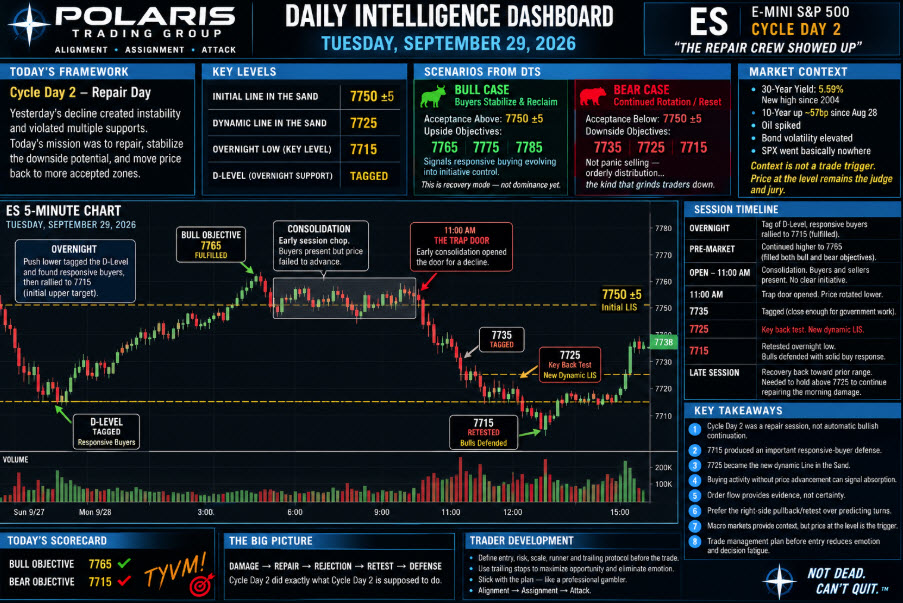
Cycle Day 2 — THE REPAIR CREW SHOWED UP 🛠️
Tuesday arrived as Cycle Day 2, and the mission was fairly straightforward:
REPAIR THE DAMAGE.
Monday’s decline had punched holes through several potential support zones, leaving the auction structurally unstable.
That meant CD2 wasn’t necessarily about launching another moon mission.
It was about stabilization, repair and finding acceptance.
Or, in PTG language:
Yesterday broke some furniture.
Today the market had to figure out where to put it back.
🌙 OVERNIGHT — RESPONSIVE BUYERS CLOCKED IN
The overnight push lower tagged the D-Level, where responsive buyers finally decided enough was enough.
They absorbed the selling, turned aggressor and drove ES back toward 7715, fulfilling the initial upside objective from the Daily Trade Strategy Briefing.
More importantly, the overnight auction had already traveled through both sides of the original roadmap:
🔴 Bear objective: 7715 — FULFILLED
🟢 Bull objective: 7765 — FULFILLED
TYVM. 🎯
With both objectives having been visited, the battlefield shifted from prediction to observation.
Where would the auction establish acceptance?
🎯 MORNING BATTLE LINE — 7750 ±5
The initial framework centered around:
LINE IN THE SAND: 7750 ±5
Above it, responsive buying had an opportunity to evolve into initiative control.
🟢 Bull Roadmap
7765 → 7775 → 7785
But there was an important distinction:
This remained recovery mode — not dominance.
The Bulls had repaired some drywall.
Nobody had handed them the deed to the house.
Below 7750, the auction remained vulnerable to continued rotation.
🔴 Bear Roadmap
7735 → 7725 → 7715
This wasn’t necessarily a crash scenario.
It was the potentially more annoying alternative:
Orderly distribution.
The slow, grinding variety that turns perfectly reasonable traders into philosophers.
🔔 RTH — CHOP BEFORE THE DROP
The opening portion of the session became an exercise in patience.
Price consolidated.
Buyers were present.
Sellers were present.
Neither side initially possessed enough aggression to force meaningful expansion.
And that provided an excellent live lesson for the room:
Buying activity does not automatically mean price must rise.
If aggressive buyers continue hitting offers but price fails to advance, passive sellers may simply be absorbing that demand.
Likewise, order flow cannot tell us with certainty that all sellers are finished.
We observe the evidence.
We identify the structure.
Then we wait for price to confirm.
No crystal balls required.
🧠 THE PAC-MAN LESSON
The morning discussion turned into an excellent lesson on order flow and market structure.
Think of liquidity like Pac-Man pellets.
Price keeps consuming available liquidity at a level.
Eventually one of two things happens:
The liquidity replenishes and holds…
or Pac-Man eats through the wall and price moves to the next neighborhood.
That is why PTG continues emphasizing the right-side pullback rather than trying to predict precisely where a turn should occur.
Let somebody else catch the knife.
We’ll wait until it stops bouncing around the kitchen.
🏦 MACRO CROSSCURRENTS ENTERED THE ROOM
Meanwhile, the broader macro backdrop wasn’t exactly whispering sweet nothings.
Treasury yields were pushing sharply higher, oil had strengthened and bond volatility remained elevated.
Yet equities initially refused to collapse.
That divergence reinforced an important point:
CONTEXT IS NOT A TRADE TRIGGER.
Options flow, VIX, oil, yields, the dollar and SPX derivatives can all provide useful context.
But ultimately…
ES still has to trade the level.
Price remains the final judge and jury.
🪤 11:00 AM — THE TRAP DOOR OPENED
After spending the early session consolidating, the market finally made its move.
Around 11:00 AM, the floor disappeared.
ES rotated lower and began retracing the overnight recovery.
First came 7735.
Tagged.
Close enough for government work. 😎
Then came the more important test.
7725
This became a critical back-test zone.
And underneath sat the overnight battleground:
7715
Price ultimately retested the 7715 overnight-low target zone, bringing the auction right back to where responsive buyers had previously demonstrated interest.
Now came the test:
Were they still home?
They were.
🐂 BULLS DEFENDED 7715
Buyers responded aggressively around the overnight low and produced a solid buying response.
That defense mattered.
The market had pushed lower, tested an established reference and found demand rather than immediate continuation.
But defending a level and controlling an auction are two entirely different things.
The Bulls had stopped the bleeding.
Now they needed to move the patient.
Price returned toward the prior low/range, establishing the next critical decision point.
⚔️ NEW DYNAMIC LINE IN THE SAND — 7725
By late morning the battlefield had changed.
NEW DYNAMIC LIS: 7725
That became the tactical dividing line.
Above 7725
Buyers had an opportunity to continue repairing the morning damage and push price back into the prior accepted range.
Below 7725
The auction remained vulnerable to another test of 7715 and potentially lower should responsive demand finally disappear.
In other words:
Defending the castle gate was nice.
Getting back inside the castle was better.
🎓 TRADER DEVELOPMENT — THE PLAN BEFORE THE TRADE
One of the strongest educational discussions of the session had little to do with predicting the next ES tick.
It centered on trade management.
Why move a runner to breakeven?
Why use a trailing stop?
Why define the management protocol before entering the trade?
Because once money is moving…
emotion starts negotiating.
The room correctly connected the concept to yesterday’s blackjack discussion.
A professional gambler doesn’t decide whether to hit or stand because the dealer suddenly looks intimidating.
The rules were established beforehand.
Trading should operate the same way.
Define:
Entry.
Initial Risk.
Scale.
Runner.
Trailing Protocol.
Then execute.
The objective isn’t to eliminate losing trades.
The objective is to eliminate unnecessary decisions while the trade is live.
That reduces decision fatigue and prevents P&L from becoming the trader’s strategy.
📊 CYCLE DAY 2 SCORECARD
The session behaved exactly like a market undergoing repair.
Monday’s decline had created instability.
Tuesday attempted to stabilize that instability.
The auction rallied from the D-Level, fulfilled the initial recovery objectives, failed to establish sustained upside dominance, rotated lower through the morning structure and ultimately retested the 7715 overnight-low target zone.
Responsive buyers defended it.
That defense shifted attention immediately back toward 7725, which became the new dynamic LIS.
So while plenty of price traveled across the screen…
the structural story remained remarkably clean:
DAMAGE → REPAIR → REJECTION → RETEST → DEFENSE.
That’s Cycle Day 2 doing Cycle Day 2 things.
🧭 PTG TACTICAL TAKEAWAY
Tuesday was another reminder that traders don’t need to predict every market move.
They need a framework.
The original levels identified the battlefield.
The auction did the rest.
7715 mattered.
7750 mattered.
7725 became the dynamic pivot.
And when the market changed character…
the framework changed with it.
That’s the difference between having an opinion and having a process.
Educational Takeaways
- Cycle Day 2 was a repair session, not an automatic bullish continuation day.
- Responsive buying from a support level does not equal initiative control.
- Heavy buying without price advancement can signal absorption.
- Order flow provides evidence — not certainty that buyers or sellers are finished.
- Prefer the right-side pullback/retest over blindly anticipating reversals.
- Macro markets provide context, but price at the level remains the trigger.
- 7715 produced an important responsive-buyer defense.
- 7725 emerged as the new dynamic Line in the Sand.
- Define trade-management rules before entering the trade.
- Trailing stops and predefined protocols help reduce emotion and decision fatigue.
- Most importantly:
STICK WITH THE PLAN.
Because markets will happily provide all the emotion you could ever want.
There’s absolutely no reason to bring your own.
Alignment → Assignment → Attack.
Take the Triple-A setups.
Manage the $RISK.
And as always…