
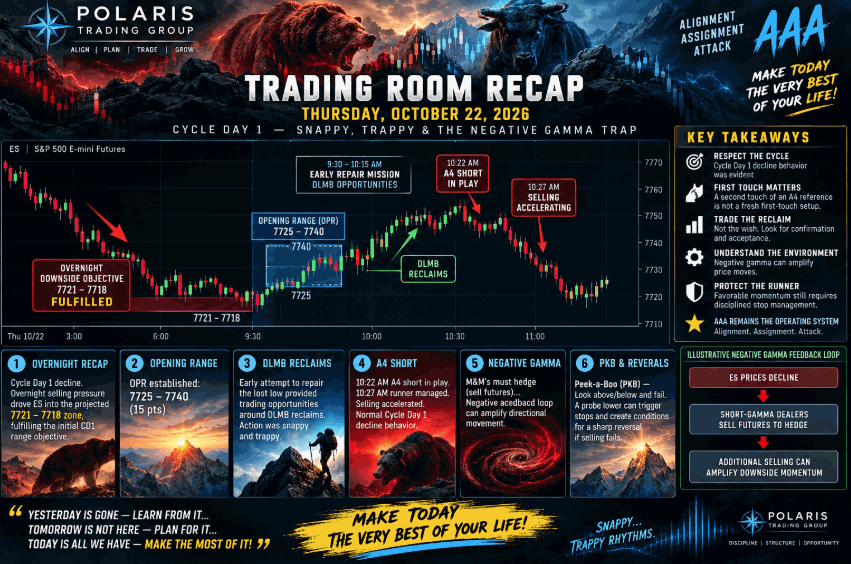
Cycle Day 1 — Snappy, Trappy & the Negative Gamma Trap
The Bears brought the pressure. The Bulls attempted the repair. And the market reminded everyone that trading without alignment is a very expensive recreational activity.
Overnight: The Bears Completed Their First Assignment
Thursday’s session began with the market already doing what a classic Cycle Day 1 is supposed to do: declining.
Overnight selling pressure drove ES directly into the projected 7721–7718 downside target zone, fulfilling the initial CD1 range objective before the regular trading session even opened.
Mission accomplished.
But there was a catch.
The broader market remained trapped inside a larger trading range characterized by violent intraday reversals, prolonged compression, and sudden directional expansions.
Translation?
Just when traders thought they had the market figured out, Mr. Market changed the combination to the safe.
The PTG playbook remained straightforward:
Alignment. Assignment. Attack. (AAA)
No guessing. No chasing. No heroic attempts to catch falling knives.
9:30–10:15 AM | The Opening Repair Mission
The opening bell brought an early attempt to repair the previously lost low, with the D-Level Money Box (DLMB) becoming an important reference on the move higher.
By 9:37 AM, the Opening Range (OPR) had been established:
ES OPENING RANGE
OPR Low
7725
OPR High
7740
Range
15 pts
The early advance provided opportunities around DLMB reclaims, but price action was anything but smooth.
By 10:04 AM, the room was observing the DLMB playing out on reclaims.
Shortly afterward came the day’s defining description:
“Snappy …Trappy rhythms.”
An accurate diagnosis of an auction that seemed determined to punish both premature buyers and impatient sellers.
The lesson was simple: A reclaim is meaningful only when price demonstrates acceptance. A momentary poke above resistance is not a signed invitation to mortgage the farm.
10:15–10:45 AM | The Bears Reloaded
At 10:22 AM, PTGDavid identified an A4 short in play.
By 10:27 AM, a runner was being managed.
One minute later, the selling accelerated.
The early recovery effort had given way to renewed downside pressure, consistent with normal Cycle Day 1 decline behavior.
This was precisely why the PTG methodology emphasized maintaining directional alignment rather than developing an emotional attachment to the previous trade.
The market doesn’t care where you bought. It doesn’t care where you sold. And it certainly doesn’t care how confident you sounded five minutes ago.
The key was recognizing the shift and executing accordingly.
10:35 AM | Negative Gamma Entered the Battlefield
The morning’s selling pressure gained an additional explanatory dimension when PTGDavid highlighted negative gamma positioning.
In a negative gamma environment, options dealers who are short gamma may need to sell futures as the underlying market declines and buy futures as it rises to rebalance their exposure.
That dynamic can amplify existing directional movement.
Illustrative negative gamma feedback loop
ES prices decline
Short-gamma dealers sell futures to hedge
Additional selling can amplify downside momentum
Potential reinforcing feedback loop — not a guaranteed outcome
As PTGDavid summarized:
“M&M’s must hedge (sell futures)…Negative feedback loop.”
The discussion also turned toward the put wall and the importance of recognizing when apparent stabilization might give way to renewed directional expansion.
The put wall was a useful reference, but it wasn’t an impenetrable concrete bunker.
A trader in the room cited historical 0DTE put-wall statistics from Mnethor Q. Those figures were shared as discussion points rather than independently verified trading probabilities.
The more durable conclusion came from the room itself:
Stay aligned. Wait for shifts. Let price do the talking.
11:00 AM–11:37 AM | The Art of the Failed Break
As the morning progressed, attention turned toward one of PTG’s most valuable reversal concepts:
Peek-a-Boo (PKB) — Look Above/Below and Fail.
A market probing beneath an established low can trigger stops, attract breakout sellers, and create the conditions for a sharp reversal if selling fails to sustain itself.
But the probe alone is not the trade.
The important information comes from the reaction: failure to continue, reclaim of the broken reference, and confirmation from price structure.
The room also discussed midpoint trade opportunities, with one participant confirming that a midpoint trade had worked.
The recurring educational theme was that traders needed to recognize the distinction between a legitimate directional breakdown and a failed auction that could reverse aggressively.
In other words:
Sometimes the market goes lower to find buyers. Other times it goes lower because there simply aren’t enough buyers.
Your job isn’t to predict which outcome is coming.
Your job is to recognize the evidence.
PTG Tactical Scorecard
| Reference | Session significance |
|---|---|
| Cycle Day | CD1 — Decline phase |
| Overnight objective | 7721–7718 fulfilled |
| Opening Range | 7725–7740 |
| A10 | In play pre-RTH |
| DLMB | Early reclaim opportunities |
| A4 Short | In play at 10:22 AM |
| Gamma | Negative positioning highlighted |
| Put Wall | Key discussion reference |
| PKB | Failed-break reversal education |
Lessons From the Trading Room
-
Respect the cycle. Cycle Day 1 decline behavior was evident overnight and again during the morning’s accelerated selling.
-
First touch matters. The room reinforced that a second touch of an A4 reference should not automatically be treated as a fresh first-touch setup.
-
Trade the reclaim, not the wish. DLMB and PKB opportunities required price confirmation.
-
Understand the environment. Negative gamma can contribute to sharper price swings and more aggressive directional movement.
-
Protect the runner. Favorable momentum still required disciplined stop management.
-
AAA remains the operating system. Alignment first. Assignment second. Attack only when the setup earns it.
Closing Perspective — The Market Rewards Preparation, Not Prediction
Thursday morning delivered a textbook reminder that the best trading opportunities don’t always come packaged in orderly trends and picture-perfect pullbacks.
Sometimes they arrive disguised as failed rallies, stop runs, negative gamma acceleration, and enough intraday whiplash to make a chiropractor consider a second career.
The overnight Cycle Day 1 downside objective was fulfilled. The opening recovery attempted to repair lost territory. Then the Bears reasserted themselves with an A4 short opportunity and accelerated selling.
The traders who maintained discipline had a structured framework for navigating those shifts.
Those attempting to predict every turn were likely discovering that hope is not an approved PTG trading indicator.
Today’s PTG takeaway:
You don’t need to know what the market will do next. You need to know what YOU will do when the market tells you what it’s doing.
And remember the morning’s message:
Yesterday is gone — Learn from it.
Tomorrow is not here — Plan for it.
Today is all we have — Make the most of it!
Make today the very best of your life.
— PTGDavid | Polaris Trading Group